Tuesday, 31 May 2022

5 Myths to take your breath away!

 Did you know Oxygen can kill you?

There’s a lot of information around about breathing – and much of it is inaccurate and unhelpful. So, in this article I’m going to bust some breathing myths!  Then, with myths busted, I’ll help you work out the quality of your own breathing and give you some techniques to breath in a way that is helpful to your health rather than damaging it!

 5 Breathing myths busted

 If you would rather you can watch a video where I share these 5 myths for Swindon Speakers club.

Myth No 1

So often I’ve heard yoga or meditation teachers say: ‘Begin by focusing on your breathing. You don’t have to change it.’ 


person sitting in lotus Yoga pose  doing a breathing practiceYet, it’s impossible for us to think about our breathing and it not change.  The simple act of awareness changes everything and that goes well beyond breathing, but let’s not get into quantum stuff! 

Breathing is a reflex like our heart beating and our digestion (thank goodness for that or we would all be dead by now!) Our breathing rate changes automatically depending on the physical needs of the body – increases if we are running for example and slows down when sleeping.

Heart rate and digestion although affected by our state of mind / our stress levels, simply thinking about slowing or speeding our heart or digestion has little noticeable effect. However our breath is the one reflex we are able to control easily.  I share how to make it more effective at the end. The simple act of thinking about your breathing changes it!

So that’s one breathing myth busted already and I’ve hardly got started. 


Myth No 2

It’s often said that we can’t survive for more than three minutes without breathing.

Yet the record for breath-holding is 24.03 min –and I’ve no idea how that’s possible either!  It does take practice but this demonstrates that it is possible!  There are also plenty of stories of people who have been in accidents and stop breathing for well over 3 min and unexpectedly survive unharmed to the amazement of the medical profession.


Myth No 3

Oxygen is the all-important gas in breathing and CO2 is a waste gas.

When I trained as I nurse we were told: under no circumstances increase the level of oxygen, given to an asthmatic, without a doctor’s permission.  Why? Because you’ll KILL them!  Yes that’s right too much Oxygen will kill you!

I know this is hard to grasp but, the crucial element in the act of breathing, is CO2. Yes, we depend on oxygen for life, but it’s an increase in carbon dioxide in our blood stream, rather than the lack of oxygen, that triggers our breathing reflex. CO2 then, is crucial not simply a waste gas.
For more on why carbon dioxide is not a waste gas.


Myth No 4

The following symptoms denote stress don’t they?

Breathlessness, excessive sighing, palpitation (rapid, strong and/or irregular heartbeat), cold hands and feet, muscle pains, dizziness, exhaustion, lethargy (lack of energy and enthusiasm), anxiety, sleep disturbance, increased blood pressure, headache, disturbed concentration and memory. 

Well no. They don’t. According to Russian scientist, Professor Buteyko, these are a mere few of the many symptoms of chronic hyperventilation.  What does that mean?  O2/Co2 balance in our blood, alters the pH of our blood, creating an overly acidic system.  This is a key component of the inflammation process which leads to many chronic problems.

As we’ve seen, for our body to work well it needs CO2 as much as oxygen.  What we think is stress and hard to control turns out to be symptoms of hyperventilation, which is much easier to control!


Myth No 5

Taking deep breaths helps when you’re stressed.

As mentioned in myth No 1, thinking of your breathing rather than the thing that is causing you to get anxious is helpful but not deep breathing per se. It will serve only to exacerbate the problems associated with hyperventilation mentioned above. The key is to focus on a slow out breath, not the in breath.


Improving breathing quality

1) Take a full relaxed breath (through your nose) and note the depth and quality of your breath on a 1 to 10 scale.

Notice if it’s more difficult to breathe in or out.

 2) Clench your buttocks and repeat point 1.  How did the tightness affect your score?

 3) Now, tighten your shoulders by shrugging them or squeezing them together in your back and breathe. What is your score now?

Release and notice what is different about your breathing now.  Note, where is it on the scale 1 to 10 now?


 Breathing Techniques


 A) The control pause

Measure your breathing health and unblock your nose

To measure your control pause, sit in a comfortable position in an upright chair, relax and breathe out. Then breathe in normally and out again, holding your nose after the out breath.

Using a stopwatch, count how many seconds you can hold your breath, until you feel the need to breathe in again. Then, breathe in through your nose without gulping air.

The number of seconds you counted, before breathing in, gives you your control pause.

The ideal control pause is sixty seconds, but a control pause of forty to sixty denotes good health.

A control pause of thirty or less means you’re breathing enough for at least two people will probably have some of the symptoms of hyperventilation on a regular basis.

B) Square breathing

Square breathing also known as (box breathing), is a simple practice you can use any time in the day.  You can do it anywhere – sitting in traffic, waiting for someone or for any form of transport.
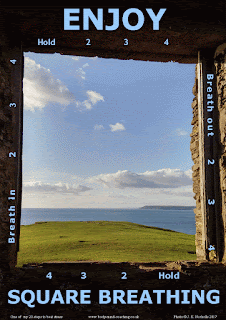
 

Square window with view out to sea and clouds in blue sky

  It’s especially good to use first thing in the morning and last thing at night.  It helps unblock your nose as does the control pause mentioned above.

  I teach this to almost all my clients as it’s relaxing and helps with sleep issues. Both of which are key to better health.

   You simply need to be able to count to four. Breathe in for a count of four - then hold for four counts, then breathe out for four counts and hold your breath for four counts before starting again.   This is square breathing.

  The pauses are the most important part of this breathing practice. You may notice this is when your thoughts will begin to still. 


You can follow along with this video where I share the technique 26 min into a presentation about stress.

The effects are cumulative, so the more you introduce it into your day, the more you will benefit from lower blood pressure, improved ability to deal with difficult situations and better sleep (quantity and quality).


What changes do you notice now after just a few rounds?


c) Feldenkrais breathing 


This breathing practice helps increase lung capacity, ease and function. 

Use it to discover how good your breathing is and to increase control and breathing capacity:

You can follow the instruction on this video:


a. Place the depth and quality of your breath on a 1 to 10 scale – note if it’s more difficult  to breathe in or out.


b. Chop up the most difficult way (in or out) first. Repeat for 3 breaths then take a pause.

 Notice any change. And then reverse the process.


c. Now place your breathing on the scale of 1to 10, what changes do you notice?

    How do you feel mentally as well as physically?

 You can follow this recording, where I take a client  through this practice. 


Whenever you realise your breathing isn’t as good as you would like, recall a positive experience and relax with the above breathing practices. When you’re in pain remember to breathe OUT, muscles will relax more easily and pain will decrease! Square breathe at least twice a day!

Until next time, Be well.

Julie Nicholls Body~Mind Coach  LCSP(Phys), IEMT, former RGN Tel: 01793 495551

For other resources about breathing:

Videos:  

Learn how to improve deep breathing for stress and anxiety

Breathing function at 16min into this video

 Books: 

ALEXANDER STALMATSKI, Freedom from Asthma, https://amzn.to/3t3lsZi

Buteyko’s revolutionary treatment https://amzn.to/3M00ukF

Asthma free in 21days  https://amzn.to/3wYeG8u

Or book a taster session 

This post contains Amazon links for which I may get a small commission if you purchase through the link.

Monday, 30 May 2022

CO2 is essential for your life

 Why carbon dioxide is not a waste gas!

In the second half of the 18th century, Lavoisier gave a gas the name oxygen – from that day viewed as the gas of life. By contrast, scientists saw carbon dioxide, shown to kill mice at high concentrations, as poisonous. Or at best a waste gas. 

X-ray of lungs
Yet a later experiment with baby mice, placed in a container with pure oxygen, showed a dark sided to the gas of life. It made the mice blind. But this experiment and its outcome aren’t common knowledge.


The common, but false, belief that after inhaling oxygen we exhale a waste gas called carbon dioxide (CO2) has led to a fundamental misunderstanding of asthma. In fact, carbon dioxide is one of the most important chemical regulators of the human body. 

It monitors the activity of the heart, the blood vessels and the respiratory system. As Haldane discovered in 1905, the amount of carbon dioxide in our blood regulates the rate and depth of our breathing.

When we remove carbon dioxide from the body in undue quantities, by excessive artificial ventilation of the lungs, there occurs a gradual failing of the heart and circulation with death resulting - as Professor Yandell Henderson of Yale discovered in 1909.

Levels of Oxygen VS Carbon dioxide

The level of oxygen in the room where you’re reading this is twenty per cent - the normal level for our atmosphere. It’s unlikely you’d notice if the oxygen level doubled or even tripled around you because our bodies are blind to higher levels of oxygen. 

Further, if the oxygen level dropped considerably, you’d be unlikely to notice any difference in your breathing. Only when the level drops below fifteen per cent - as it does at high altitudes - would you be aware of the difference.

Contrast that situation with carbon dioxide. Asthmatics have between 3.5 and 4.5 per cent of carbon dioxide in their alveolar air. If this were decreased by as little as 0.I percent anyone - whether asthmatic or not – would develop dizziness, palpitations, wheezing and a blocked nose. Or even a mild asthma attack.

These figures show that our bodies are fifty times more sensitive to changes in carbon dioxide levels than they are to changes in oxygen levels. It follows then that carbon dioxide is far more important to your body than oxygen.

Asthma

If an asthmatic can 'normalise' his or her carbon dioxide level by raising it to 5.5 or 6 per cent, they can get rid of their asthma. Experiments have shown that carbon dioxide levels of more than ten per cent causes loss of consciousness. Yet there is never any need to increase carbon dioxide to such an extent, and the Buteyko method (mentioned above) doesn’t involve raising carbon dioxide levels above normal.


SYMPTOMS

Chronic hyperventilators may be referred to a succession of specialists who find no evidence of organic disease. Many become chronic invalids with gross anxiety neuroses as a result of the continuance of undiagnosed, alarming symptoms. The situation is self-perpetuating in this group of people. They breathe in such a manner that their arterial carbon dioxide level is persistently low. And this may form the basis of a variety of symptoms.


This list gives some of the symptoms of chronic hyperventilation:


Cardiovascular symptoms: a fast, strong and irregular heartbeat, restricted blood vessels.


Respiratory symptoms: narrowing of the bronchial tubes, breathlessness, air hunger, excessive sighing, chest pain.


Neurological symptoms: tingling or pricking in peripheral nerve endings, dizziness, lack of co-ordination, disturbance of vision, disturbance of hearing, black-outs.


Musculoskeletal symptoms: muscle pains, involuntary contractions, tremors, cramps, intermittent muscle spasms.


General symptoms: exhaustion, weakness, sleep disturbance, headache, poor concentration and memory, anxiety, panic attacks, phobic states -irrational fears or aversions, excessive sweating.


According to Professor Buteyko, these are a mere one-tenth of all the symptoms of chronic hyperventilation. He believes they may cause headaches, migraine, chronic fatigue, schizophrenia, and of course, asthma, to name but a few.

There exists a further interesting link between asthma and epilepsy in that in both of these disorders, hyperventilation is a major cause of the attacks or fits.

To find out how to tackle these issues with simple mindful breathing: https://natural-therapy-centre.blogspot.com/2022/05/5-myths-to-take-your-breath-away.html

Or book a taster session: http://bit.ly/3I5pPbe  

 Until next time, Be WELL

Julie Nicholls Body~Mind Coach  LCSP(Phys), IEMT, former RGN Tel: 01793 495551

 Based on : ALEXANDER STALMATSKI, Freedom from Asthma, https://amzn.to/3t3lsZi


Friday, 15 April 2022

Meet Gary from GB Performance & Nutrition

I am delighted that we are able to offer a new service in 2022. Meet Gary from GB Performance & Nutrition! This is what he would like to share with you:
Hi,I am Gary

I am a highly experienced sports nutritionist and rock climbing coach, with over a decade’s worth of experience.

What excites me most about what I do is seeing client achieve their goals thanks to my support, but also their realisation that healthy food and fuelling for performance does not have to be boring, and there is always room for the things they enjoy.

I have always been interested in how the body works and this grew into studying the physiology of physical activity.

My business has its origins in 2010 when I started working with people as an instructor. I quickly wanted to go further and coach them in depth with up-to-date recommendations for training physical activity. I researched scientific and methodical methods of training clients, something that was not readily available at the time.

Nutrition became part of my business in 2017; going hand-in-hand with exercise. I believe that unless we address both sides of the coin, we will not be rewarded with the full benefits.

As a client you get access to the knowledge I have of both the physical aspects of exercise and the nutritional understanding that supports it.
One of the first steps on your journey is to recognise your needs and how nutritional recommendations can be effectively placed around both your exercise and day-to-day life. This way the result is long lasting, rather than something that lasts a week or two.

I promote an evidence-based approach, taking the science and adapting it to the individual. I employ many methods with clients, basing recommendations on what is most appropriate for them, and simplify complex ideas to make for highly practical advice. I support active individuals of all levels from amateur to professional, to achieve their goals and maximise wellbeing.

What sets me apart is having both the qualifications to effectively use and deploy the scientific literature as well as the experience to translate complex ideas into realistic, practical and easy to understand recommendations. I have attained a BSc in Sports Performance, an MSc in Sports Nutrition and hold the ISAK level 2 Technician in Anthropometry. I am listed on the Sports and Exercise Nutrition Register (SENR) and guest lecturer at local Universities.

As a client you will not find any fad diets or quick fixes, but will get honest, high-quality, and personal advice that will make a long-lasting impact, whilst being fully supported through your sessions. I use a conversational style during coaching sessions alongside an empathetic approach.

You will be guided in a conversational style through challenging your requirements, dig into the detail around physical activity and learn to be flexible with food.

If you are interested in working with me, or would simply like to know more, then please head to the website www.gbpnutrition.com and fill in the contact form.

I will be happy to help you.
Gary Buckland MSc SENR Performance Coach & Nutritionist GB Performance & Nutrition
www.gbpnutrition.com hello@gbpnutrition.com

Thursday, 9 September 2021

Accunect self-help workshop


Are you tired of falling ill every winter? 

Do your holidays get spoiled by illness or exhaustion setting in? 

Do you then struggle to get yourself back together when you get home and have to go to work?  

Or may be you would you like to do more for your children or other family members when they fall ill?

 Either way Accunect can help you!


Book a FREE 30 min session.


The session will enable you to understand how Accunect self care can help you do this and experience its benefits for yourself. 

You will get to experience this short routine. In the process you will find out how it’s related to ancient medicine, like acupuncture, as well as 21st century neuroscience.

If you benefit then a donation to the Freedom Kit bag charity I support is appreciated.

If you want learn how to do this for yourself and your family, you can join the Accunect Self care workshop.   Here are more details and booking information. 

In this video I share an insight from using Accunect


Tuesday, 11 August 2020

How Accunect can help you!


Accunect is a 3 min simple self-care practice that can transform your life!

During stressful times it is easy to loose our way with good habits and forget about the importance of taking good care of ourselves.

smiling family with Accunect self-care written across the bottom right hand corner

Last August I attended an Accunect Self- Care day in Frome. I have found  that doing the Accunect SelfCare routine, every morning since, has really helped me stay calm and more balanced during these very intense times. I am very grateful to have these tools available to me.

If you haven't experienced Accunect SelfCare during a session with me, it's a powerful energy balancing routine that you can do in 3 minutes or less - do it before bed to help you sleep or when you wake up to start the day balanced.
It includes techniques to balance both the brain and the acupuncture meridians so that you have a whole body/mind reboot to get back to health and functioning well. 

I am really impressed with the effects which is why I am happy to share details of the upcoming online workshop so you can learn and get the benefits too. 

Want to experience what it's like first?

I am offering 30 min relaxation sessions that includes Accunect in exchange for a donation to my chosen charity. Get in touch to book your taster


Healing for you and your family

Accunect SelfCare can be done on yourself and your family. It supports overall health, wellness, balance and vitality. If you want help addressing a specific health issue OR want to cultivate general health and well being this routine is a great asset.
Anyone can benefit from the very young to the very old. You don't require any previous experience.

A powerful self-healing technique:
- Balance core energy systems in 3 minutes and energise your day
- Improve health and maintain wellness for the whole family

This fun, easy, heart-centered course will change how you look at yourself and how you look at health and healing forever.

WHAT ARE THE BENEFITS?

  • Clear stress and life overwhelm, quickly
  • Increase energy levels and vibrancy
  • Improve sleep
  • Deeper sense of well-being, balance and calm
  • Gain clarity
  • Harmonize, synchronize & boost all body systems
  • Increase natural immune function
  • Improve digestion
  • Help balance emotions
  • Boost all body functions
  • Improve nervous system and brain function
  • Speed up physical, mental & emotional healing
  • Speed up the processing of life’s difficult events

JOIN NOW!

WHAT ARE YOU GOING TO GET ON THE COURSE?

  • Learn the Accunect 8 Principles™ – and how healing happens
  • Attunement to the high vibrational healing frequency of Accunect
  • Balance your brain and nervous system - brings your body out of stress mode and into healing mode, relax your nervous system and gain clarity, focus, and thinking ability
  • Balance your organs, meridians and emotions - giving your system a thorough balance and 'spring clean' every day
  • In depth knowledge of the meridian system and organs from a holistic, physical, mental and emotional perspective
  • Connection of the whole body mind system - between our physical, mental, spiritual and emotional aspects - gain an understanding of how they affect each other
  • How to balance your brain and heart connection
  • A quick energy balancing technique for any emergency situation
  • Gain understanding and insight into The Accunect Healing System, what a clinical Accunect session looks like, and how you can learn or experience more.
  • Full colour reference manual is included
  • The balances can be done on yourself, your family, your friends, your pets! Accunect® is Energy Medicine that addresses chronic and acute health problems by re-calibrating the body’s systems that get disrupted due to stress.

It’s powerful—simple—amazing—fun!

WHEN, WHERE, WHO

Date and Time: Saturday 15th August and 17th Oct 2020 10 am- 3.30 pm

 Venue: One a computer near you! 

Investment: Early bird Price £125 until 26th Sept / £150 full price.   You'll get everything you need to participate online, . A full colour reference manual will be posted to you after the course. 

 Teacher: Sarah Chave For more details www.replenishzing.com or contact sarah@replenishzing.com

Book here

Here's what some recent students have said about studying Accunect SelfCare:

  • "Thank you so much for a wonderful day. I arrived feeling out of balance and will be leaving feeling back in balance, serene and back in my body. Sarah is an incredible teacher who clearly knows a lot. I would highly recommend this course"JM Director,
  • "A wonderful day spent learning. The routine is accessible and brilliant. I am very much looking forward to using it daily on myself and on my family and in my therapy practice. Sarah taught it beautifully, keeping each of us engaged and inspired. Feels really good to have given myself a day of deep healing" NC Therapist
  • "I highly recommend SelfCare to anyone who wishes to gain a vital and priceless tool to aid healing on physical, emotional, mental and spiritual levels for yourself, your loved ones and pets." A.L ,Wiltshire
  • " I began to feel more relaxed and pain I've had for years eased. I am feeling a lot more confident and happier with myself" Dee Shaw, Wiltshire"
  • I felt a deep sense of relaxation and connection having experienced the sharing practice. This simple self healing technique is much needed in our high stress, fast paced world. Brilliant, thank you Sarah! ."Angela Gray, Wellbeing Advisor, Dorset


If you want to be kept informed of the next workshop, sign up for UP-dates. Include Accunect as a topic you want to know about. 

Of course if you have any questions please get in touch and I will be more than happy to help.